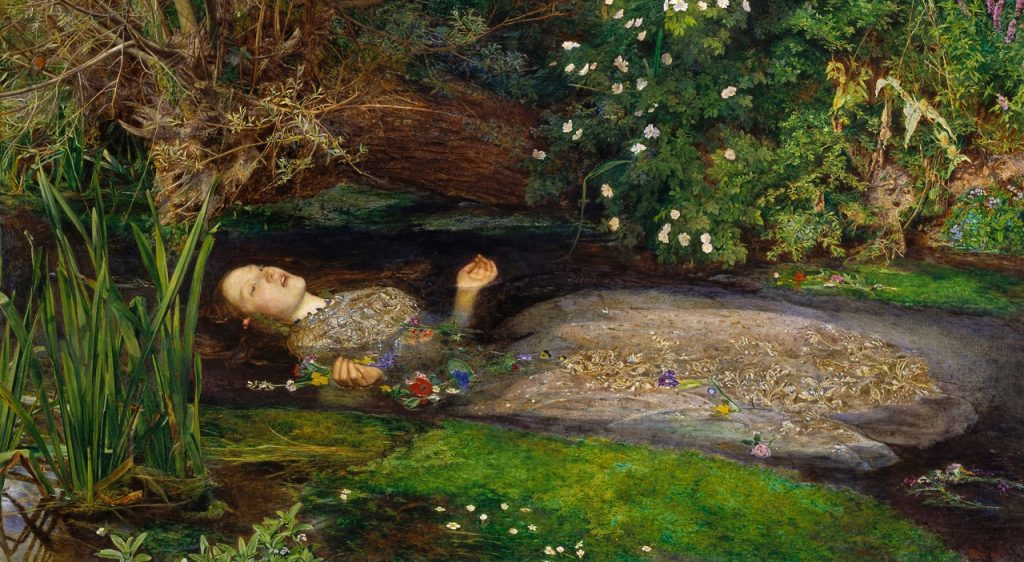


To think that the Ophelia who sings a song is the same person before her father’s death… it’s truly ominous how a death can completely change a person’s mentality and sanity. In one moment, Ophelia is completely fine, and in the next moment, it seems as if Hamlet had transferred his insanity to her. In the beginning of the play, Ophelia is shown to be calm and collected, but after Polonius died, her attitude completely turned around and headed for the worst, ultimately drowning herself. Deep down, it makes me wonder what is truly genuine with her. Is her calm and collected attitude really that true to her character?
Anyway, that is where the song comes in. The song reveals who she really is and what she really is thinking. It gives her the opportunity to express her raw emotions. It’s unfortunate that Ophelia does not have a mother to watch over her at her age. Perhaps that is why Polonius is to precious to her, because that is one of her main sources of love. Ophelia cries out, “He is dead and gone, lady, / He is dead and gone” (IV. V. 34-35). She is referring to herself as lady, as if she is imitating what other people have told her. She is reliving the moment when they told her what had happened to her father. It is engraved in her memory and the way she chose to release her emotions is reliving that moment again. Then, she talks about Hamlet, and how she is “a maid at your window, / To be your Valentine” (IV. V. 55-56). She reveals how she thought Hamlet and her were destined to be together. It is said in the past that the first woman a man sees on Valentine’s Days is his true love. She alludes to this saying, enforcing her feelings of disbelief towards Hamlet.
Filled with grief and loss, Ophelia uses repetition once more to emphasize her despair. She asks, “And will he not come again? / And will he not come again? / No, no, he is dead. / Go to thy deathbed. / He never will come again” (IV. V. 213 – 217). In the beginning, she is still in denial that her father is gone. But as she realizes, she tells him to go to his deathbed. However, she might be telling that to herself as well, for she died right after. Perhaps she was telling herself to go to her deathbed as well. This part of the song can also mean two other things: she is referring to true love and Hamlet. First off, her true love will never come again, as Hamlet has killed it off. She may be telling true love to go to his deathbed because she too no longer wants it to live as well. Secondly, she can also be referring to Hamlet. The Hamlet she knows now has completely changed from the first time she knew him. The Hamlet she once loved will never come back to her. The Hamlet she once knew has died. Her eventual realization that all three of those have died away, leaving her alone to suffer.
 Theresa's Literature Blog
I’ve always considered that songs could be telling the future, but I never really considered the possibility of the past. I really found it interesting that you viewed ‘he is dead and gone, lady’ as being her repeating what’s she’s been told. Very insightful! Good job
LikeLike
I love how you explain the importance of the allusion to St. Valentine. I also am intrigued by your parallel between her bidding good-bye to Polonius and potentially to her own life.
LikeLike
I really like how you showed how her songs on the surface seem to be about Polonius’ death and her relationship with Hamlet but may actually have given hints about her own death. I didn’t even think that the songs could be foreshadowing her own passing!
LikeLike